Paying in China 101: Why You Need Mobile Payment (And Why Cash Won’t Cut It)
Meta Description: Planning a trip to China? Learn why cash and credit cards aren't enough. Discover how to navigate China's cashless society using Alipay and WeChat Pay like a local.
So, you’ve booked your flights to the Great Wall, planned your itinerary for Shanghai, and packed your bags. You have your Visa card and a stack of Renminbi (RMB) cash ready to go. You’re all set, right?
Not quite.
China is arguably the most advanced cashless society in the world. For travelers arriving for the first time, the payment landscape can be a major culture shock. The way you pay for a coffee in New York, London, or Tokyo works very differently in Beijing or Shenzhen.
This guide will explain exactly why reliance on cash and plastic cards will slow you down, and how to embrace the "Scan and Go" culture to travel like a pro.
The Problem: Why "Cash is King" Doesn't Apply Here
Ten years ago, cash was essential in China. Today, it is becoming increasingly obsolete in daily life. While Chinese law states that merchants technically cannot refuse cash, the reality on the ground is different.
1. The "No Change" Dilemma
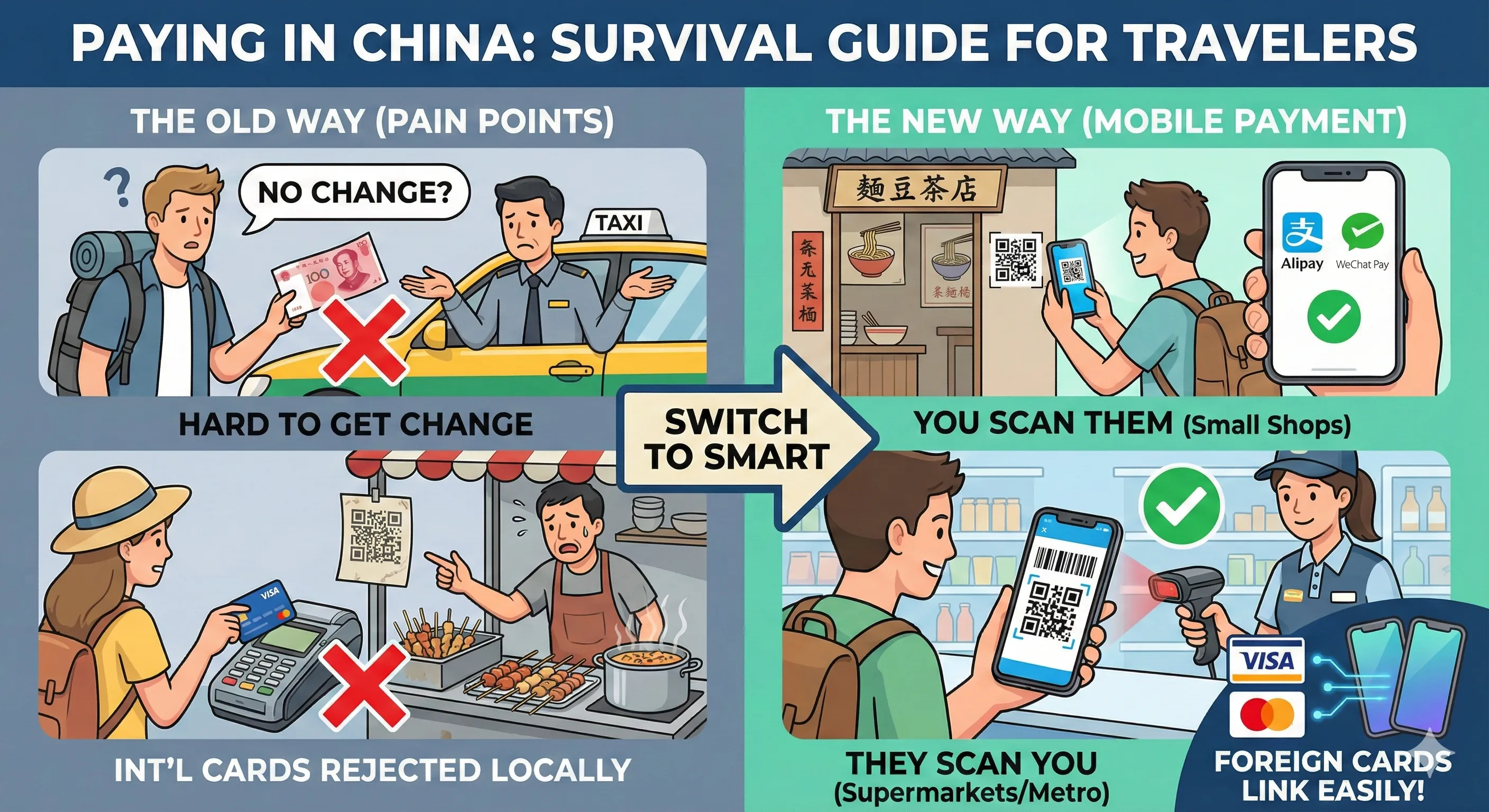
You might hand a taxi driver a 100 RMB note for a 20 RMB ride. Often, the driver simply won't have the physical change to give back to you because their last 50 passengers paid digitally. This can lead to awkward delays or forcing you to overpay.
2. Vending Machines and Kiosks
From buying a subway ticket to grabbing a bottle of water from a vending machine, many automated systems in China are now completely digital. They often do not possess coin slots or bill validators—only a QR code scanner.
3. Hygiene and Speed
In busy restaurants or street food stalls, handling cash is viewed as unhygienic and slow. Merchants prefer the instant confirmation of a digital ping over counting notes.
The Limitation: Why Your Credit Card Won't Save You
"But I have my Platinum Visa/Mastercard," you might say. Unfortunately, outside of specific high-end bubbles, your international credit card is largely powerless.
- Where it WORKS: 5-star international hotel chains, high-end Michelin restaurants, and luxury shopping malls in Tier-1 cities (Shanghai, Beijing).
- Where it FAILS: Taxis, convenience stores (7-Eleven, FamilyMart), local eateries, museums, public transport, and practically anywhere else.
Most local card terminals run on the UnionPay network. Unless your card has a UnionPay logo, it will likely be rejected at a standard Point of Sale (POS) terminal.
The Solution: Welcome to the World of QR Codes
To survive and thrive in China, you need to live on your phone. The entire economy runs on two "Super Apps": Alipay (Zhifubao) and WeChat Pay (Weixin Pay).
It doesn't matter if you are buying a roasted sweet potato from a street vendor for $1 or a designer bag for $1,000—you will use one of these two apps.
How It Works: The Two Scenarios
Using mobile payment is incredibly simple. It generally works in two ways:
You Scan Them (The Static Code):
- The Scene: A small noodle shop, a taxi, or a fruit stand.
- The Action: You open the app, tap "Scan," point your camera at the merchant's QR code (usually printed on a piece of paper or a sticker), enter the amount you owe, and confirm. Show the "Success" screen to the merchant.
- Pro Tip: This is common for small transactions.
They Scan You (The Dynamic Code):
- The Scene: A supermarket (like Walmart/Carrefour), a convenience store, or a subway turnstile.
- The Action: You open the app and tap "Pay/Receive." A unique QR code and Barcode appear on your screen. The merchant scans your phone with their heavy-duty scanner gun. The money is deducted instantly.
Is it Friendly for Foreigners?
Yes! As of late 2023 and continuing into 2025, both Alipay and WeChat have made massive improvements for international travelers.
- No Chinese Bank Account Needed: You can now link your international Visa, Mastercard, JCB, or Discover cards directly to the apps.
- English Interfaces: Both apps offer full English translations.
- High Limits: Transaction limits have been raised to accommodate traveler spending.
How to Get Started
Ready to set this up before your plane lands? It is highly recommended to download and register these apps before you arrive in China to ensure your identity verification goes smoothly.
We have prepared detailed, step-by-step guides to help you install and link your foreign cards:
- 👉 [Click Here for the Ultimate Guide to Setting Up Alipay for Foreigners] (Link this to your Alipay installation article)
- 👉 [Click Here for the Step-by-Step Guide to WeChat Pay for Tourists] (Link this to your WeChat installation article)
Summary
Don't let payment anxiety ruin your trip. While carrying a small amount of cash (200-500 RMB) is a good backup plan for emergencies, Mobile Payment is the key to unlocking the real China experience.
Once you scan your first QR code to rent a shared bike or buy a dumpling, you’ll wonder how you ever traveled without it.